The Pay Small Small Solar Guide for Nigerian Shops, Offices, and SMEs in 2026
The complete 2026 guide to pay small small solar financing for Nigerian SMEs. How it works, what deposit you need, what monthly payments look like, what solar costs for different business types (shops, offices, salons, restaurants, cold rooms), and how SunFi makes solar accessible without the upfront cost wall
July 2, 2026 3 minutes
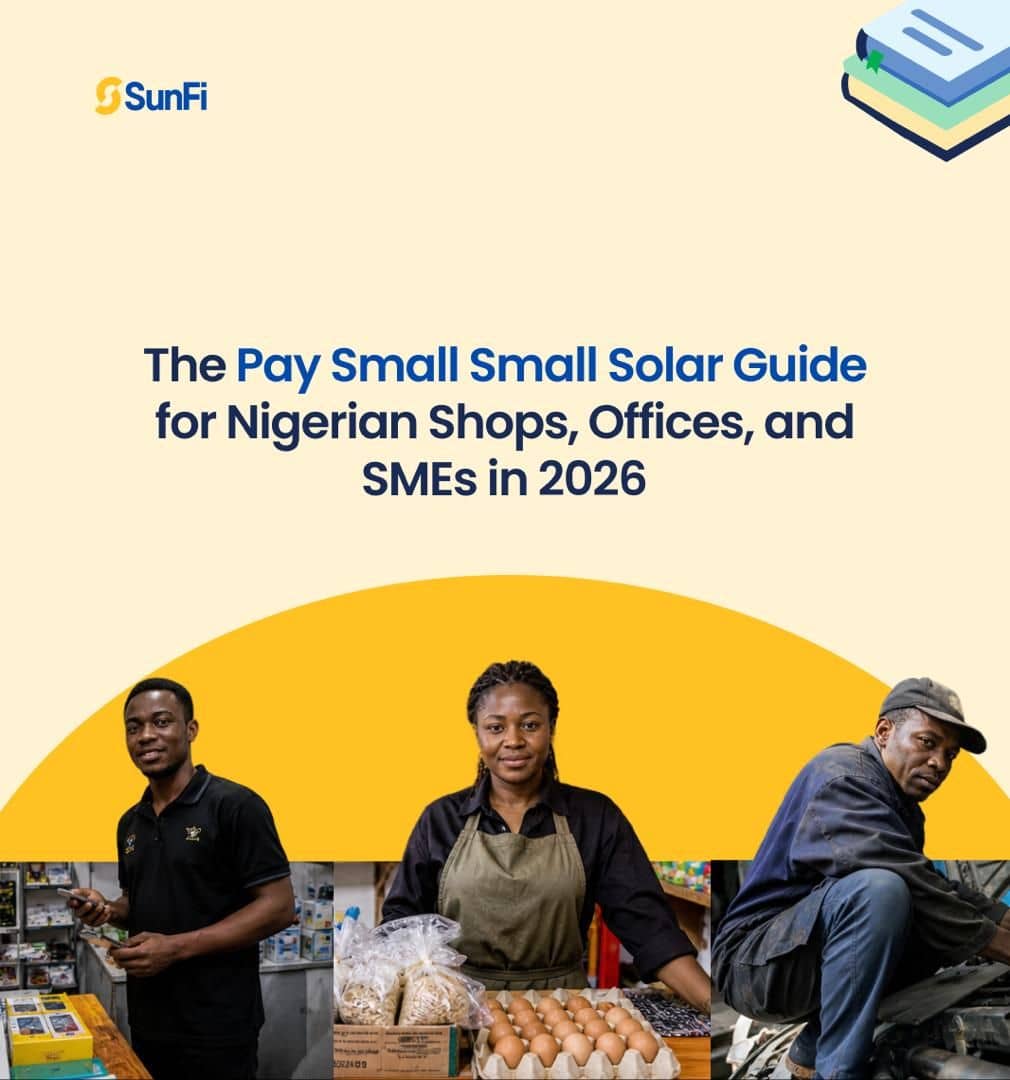
It is 2pm on a Wednesday in Computer Village, Ikeja. Tunde's phone repair shop has been without power for three hours. The diesel generator outside is running low. A queue of customers waiting for screen replacements is getting restless. Tunde knows he needs a permanent solution.
He has looked at solar prices online. Two million naira for a system that would properly power his shop. The number hits him like a wall.
Where does he get two million naira? Take a bank loan? Empty his daughter's school fees savings? Wait another year hoping things improve?
Tunde is not alone. Across Nigeria, millions of small business owners are stuck behind the same wall every single day.
Nigerian SMEs spend between ₦80,000 and ₦300,000 every month on diesel, grid tariffs, generator maintenance, and lost productivity from power cuts. That is roughly ₦1 million to ₦3.6 million per year going out the door just to keep the lights on. Most of these business owners already know solar is the answer. The problem is not awareness. The problem is the upfront cost wall.
This is the solar financing problem in Nigeria. And this is exactly what pay small small was built to solve.
What Is Pay Small Small for Solar and How Does It Actually Work in Nigeria?
Pay small small is the simple Nigerian name for a structured payment plan model: you pay a deposit, then spread the rest of the cost over some months. At the end of the term, the solar system is fully yours.
Think of it the way Nigerians already think about buying property, vehicles, or appliances over time. You do not need the full ₦2 million today. You need enough for a deposit, and a steady income that can carry the monthly payment until the system is paid off.
SunFi designed payment terms specifically for Nigerian cash flow patterns. Most Nigerian SMEs and salary earners do not have lump sums sitting in their accounts. They have monthly income. Pay small small turns solar from a lump-sum problem into a monthly expense, often less than what the business is already spending on diesel and tariffs.
For the full breakdown of how SunFi structures repayment, see our piece on solar payment plan methods.
Why Are Nigerian SMEs Choosing Solar Over Generators in 2026?
Three things have shifted that make 2026 different from any previous year.
Diesel and petrol prices keep climbing. Subsidy removal is fully baked in, and the naira's continued slide against the dollar means imported fuel costs more in real terms every quarter. Your monthly fuel spend in 2026 is materially higher than it was in 2024, and 2027 may be worse still. We covered this in detail in our piece on why Nigerian fuel prices aren't done climbing.
Band A and B tariffs are no longer a workaround. The shift to commercial-rate electricity for higher-band consumers means even when NEPA is on, the bill is significant. For SMEs on Band A, monthly grid costs can rival what the generator burns through.
Solar payment terms finally work. A decade ago, going solar required millions paid upfront. Today, pay small small with SunFi lets you spread the cost over 3 to 9 months at amounts often lower than what you already spend on diesel and tariffs combined. The math has crossed the threshold. Solar is no longer just the cleaner choice. For most Nigerian SMEs, it is also the cheaper choice.
How Do I Know What Size Solar System My Business Actually Needs?
Before pay small small can do its job, you need to know what size system fits your business. Most SME owners over- or underestimate their power needs because they have never written it down.
Here is the quick load audit every Nigerian business owner should run:
List every electrical item that runs during business hours. Note the wattage of each (most appliances list it on a rating plate). Estimate how many hours per day each item actually runs. Add it all up.
A small shop running lights, a fan, a phone charging station, and a security camera might use 2 to 4 kWh per day. An office with five laptops, lighting, two ceiling fans, a router, and a small fridge can land at 8 to 12 kWh per day. A salon running clippers, hair dryers, lights, and a wall-mounted TV often hits 6 to 10 kWh.
These numbers drive everything else: the panel sizing, the battery capacity, the monthly financing payment. Skip the load audit and every recommendation that follows is guesswork.
For a deeper walkthrough, see our solar system sizing guide for Nigerian homes and businesses.
What Solar Setup Works for Nigerian Retail Shops?
For a typical Nigerian retail shop with lights, a fan, phone charging, a small fridge for cold drinks, a sound system, and a security camera, a 1 to 2 kVA system covers the load comfortably.
This is the range where products like the ColaSolar 2000 and the Itel Power Tank live. No installation required for most setups. You plug it in to charge during the day, and it powers the shop through evening hours and any NEPA gaps.
The total cost typically lands under ₦1 million, and often runs less than what shop owners currently spend on small generator fuel in accumulation.
For shops with extra lighting, multiple fridges, or late opening hours, a 2.5 to 3 kVA system handles the larger load.
What Solar Setup Works for Nigerian Offices and Co-Working Spaces?
Offices have higher and more sustained loads than shops. Multiple computers, lighting, ceiling fans or air conditioning, networking equipment, printers, and pantry appliances all running through the working day.
A small office with three to five people typically needs a 2.5 to 3.5 kVA system. Larger offices with air conditioning, server rooms, or ten-plus staff need a 5 to 6 kVA system with custom design. This is SunFi Concierge territory: full installation, site assessment, and ongoing support. Office downtime is too expensive to risk on an undersized DIY setup.
What Solar Setup Works for Nigerian Salons, Barbershops, and Tailors?
Service businesses are where productive use of energy becomes most obvious. Every minute the power is off is a minute you cannot serve a customer.
Salons and barbershops run clippers, hair dryers, blow dryers, lights, and often a wall-mounted TV for waiting customers. A 2 to 3 kVA system handles a single-chair operation comfortably. Multi-chair salons need 3.5 kVA and up.
Tailors typically run sewing machines, an iron, lighting, and a small fan. A 1.5 to 2 kVA system covers a single tailor. Workshops with multiple machines need scaled-up capacity.
Barbershops are often the easiest case. Clippers and lights draw modest power, and the constant on-off cycle of clipper use fits perfectly with solar's daytime production curve. A 1.5 kVA system runs a small shop reliably.
The common thread across service businesses: every hour of stable power converts directly to revenue. That is why these owners often have the strongest financial case for pay small small. Payback periods shorten when downtime literally means lost income.
What Solar Setup Works for Nigerian Restaurants, Bars, and Cold Rooms?
Food businesses are the heaviest power users in the SME range, and the ones where solar pays back fastest because of the constant refrigeration load.
Small restaurants and bars typically need 3 to 5 kVA, depending on whether they are running multiple fridges, freezers, blenders, lighting, and entertainment systems. The challenge is the variable peak load when multiple appliances run simultaneously.
Cold rooms are a special case. They need consistent 24-hour power for refrigeration. An undersized system can spoil inventory in hours, so cold room solar systems are typically sized with 30 to 50% headroom and 2 to 3 days of battery autonomy. This is full Concierge territory, no plug-and-play shortcuts.
The cost of one spoiled freezer of fish or meat often exceeds a month's solar payment. Reliability is not a nice-to-have. It is the entire business.
How Much Does Solar Actually Cost for a Nigerian SME in 2026?
Real price ranges by business size:
- Small shops and single-chair service businesses (1 to 2 kVA): ₦500,000 to ₦1.2 million
- Mid-size offices, multi-chair salons, mid-tier shops (2.5 to 3.5 kVA): ₦1.2 million to ₦2.5 million
- Larger offices, restaurants, cold rooms (4 to 6 kVA): ₦2.5 million to ₦5 million
- Industrial or multi-location operations (10 kVA+): ₦5 million and up, full custom design
These numbers move with naira-dollar exchange rates and component costs, so always get current quotes. The structural point: most Nigerian SMEs spend more on diesel and tariffs over five years than the upfront cost of a properly sized solar system. The fuel versus solar cost breakdown lays out the long-term math.
How Does SunFi Pay Small Small Financing Work for SMEs?
It is meant for products You do not pay the full system cost upfront. SunFi pay small small spreads the cost over 3 to 12 months:
A deposit of 30% to 35% of system cost.
Monthly payments structured to fit your business cash flow.
Full ownership of the system at the end of the term.
For larger commercial installations, SunFi structures business-specific financing directly with the business, often with longer tenors and customised terms based on cash flow.
How Does SunFi Concierge Handle Bigger Solar Installations?
For larger or more complex SME setups, SunFi Concierge takes the entire project off your plate.
What is included: site assessment and energy audit, custom system design built for your specific load, installer matching and project management, installation and commissioning, ongoing maintenance and support, and financing structured into the engagement.
Concierge is the right path when your business loads exceed what plug-and-play systems can handle, you cannot afford downtime during installation, you want professional design rather than DIY guesswork, or the financial stakes (cold room inventory, server uptime, customer experience) justify white-glove handling.
This is also the path most often taken by businesses scaling their clean energy footprint, as covered in our piece on clean energy businesses in Nigeria.
What Are the Common Solar Mistakes Nigerian SMEs Should Avoid?
After watching thousands of Nigerian SMEs adopt solar, the same mistakes keep recurring.
Sizing for the average day, not the bad day. A system that just barely covers your typical Tuesday will fail in July when three cloudy days come back-to-back. Always design for the difficult week.
Cutting battery capacity to hit a price point. Batteries are the most expensive component, which makes them the most tempting to undersize. Resist the temptation. An undersized battery means rationing power exactly when you need it most.
Ignoring peak load. Your inverter must handle every appliance running simultaneously, not just the average daytime draw. The iron, kettle, and AC compressor all kicking in together is what trips undersized systems.
Buying from non-specialists. Solar is a multi-decade investment. The installer matters as much as the equipment. SunFi-certified installations come with verifiable warranties and ongoing support.
Treating solar as backup, not as primary. Solar designed as a generator replacement, not a backup-only system, is where the financial returns come from. Backup-only thinking limits what the system can do for your business.
How Do I Start Pay Small Small Solar With SunFi Today?
Three next steps.
Step 1: Run the numbers. Use the SunFi energy calculator at sunfi.co to get a starting recommendation for your business in under a minute. No commitment.
Step 2: Chat with a SunFi agent on WhatsApp for a tailored recommendation. System size, cost range, financing options, timeline.
The shift to solar is not theoretical for Nigerian SMEs in 2026. It is happening, quietly and profitably, business by business. The longer you wait, the more naira flows out to diesel and tariffs and never comes back.
Pay small small is how Nigerian SMEs finally cross the upfront-cost wall and turn power into progress.
Ready to Power Your Nigerian Business With Solar?
Chat with a SunFi agent on WhatsApp or call 02013306111 for a tailored recommendation.
Use the SunFi energy calculator at sunfi.co to see your system size and monthly payment in under a minute.

Henry Adepegba
ABOUT AUTHOR
SEO Associate
Leave a Reply
Your email address will not be published.