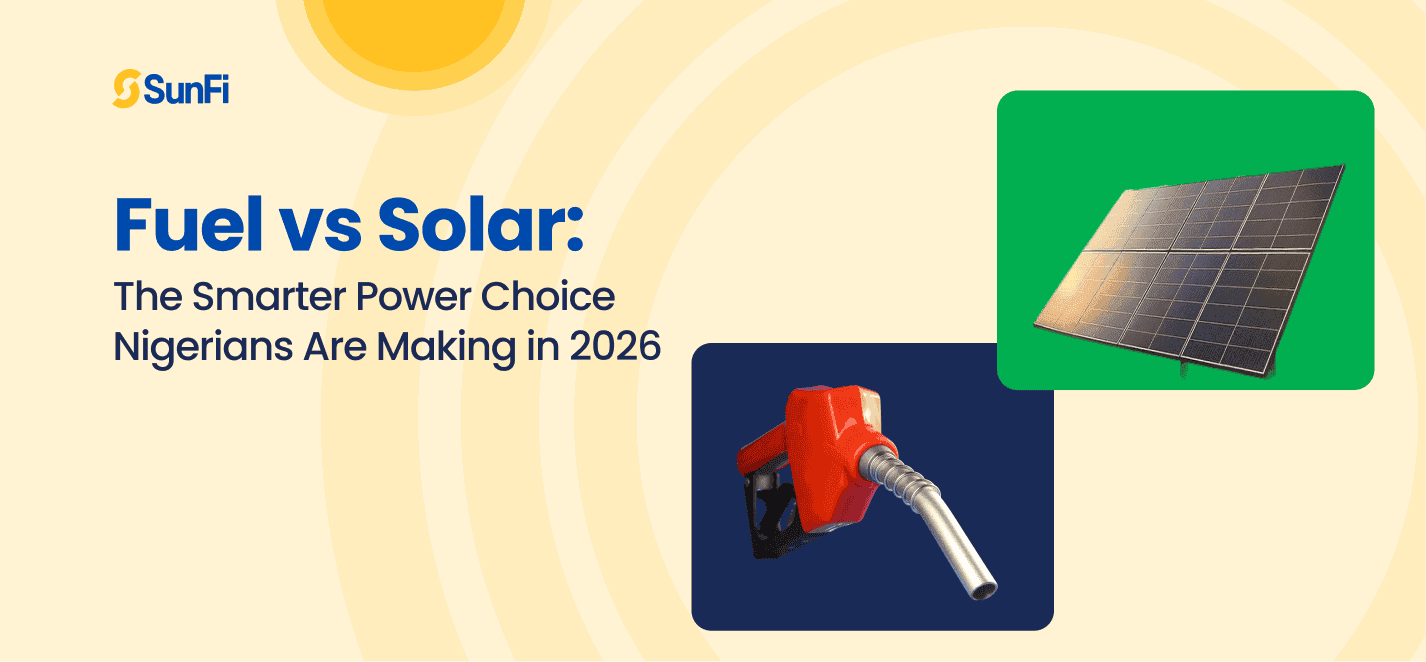
Generator vs Solar Cost in Nigeria: Which One Really Makes Sense in 2026?
Compare the true cost of running a generator versus going solar in Nigeria in 2026. From daily fuel burn at ₦700 per litre to maintenance, repairs, and the hidden costs Nigerians often forget, this breakdown shows why more households are making the switch. Includes year-by-year payback calculations, factor-by-factor comparisons, and how flexible financing makes solar accessible without the upfront pressure.
April 14, 2026 3 minutes
If you rely on a generator, you've probably said this before:
"The cost of fuel has increased again, but what choice do I have?"
It's a real struggle, and you're not alone. Millions of Nigerians are asking the same question as the cost of living without steady power continues to rise.
Between unstable grid electricity and fuel prices that seem to climb every few months, keeping the lights on has become both stressful and expensive.
But here's the shift happening in 2026:
More Nigerians are moving away from generators and choosing solar instead. Not because it's trendy, but because the maths finally makes sense.
Let's break down the real generator vs solar cost in Nigeria.
The True Cost of Running a Generator in Nigeria
Generators have been the backup power solution for decades. They work, yes — but at what cost?
Here's what generator ownership really looks like when you add up everything:
Fuel Costs
This is the biggest expense, and it never stops.
Let's do the maths for a typical 3.5kVA generator:
Let's do the maths for a typical 3.5kVA generator at today's fuel price of ₦700 per litre.
Light use (4 hours daily). Roughly 2 litres a day. That's about ₦42,000 every month, or just over ₦500,000 a year on fuel alone.
Moderate use (8 hours daily). Roughly 4 litres a day. That's about ₦84,000 every month, or just over ₦1 million a year.
Heavy use (12 hours daily). Roughly 6 litres a day. That's about ₦126,000 every month, or ₦1.5 million a year.
And remember, those numbers are at today's prices. What happens when fuel hits ₦1,000 per litre?
That's ₦500,000 to ₦1.5 million per year on fuel alone.
And that's at today's prices. What happens when fuel hits ₦1,000 per litre?
Maintenance Costs
Generators require regular servicing:
- Oil changes every 2-4 weeks (₦5,000 - ₦15,000)
- Spark plug replacement (₦3,000 - ₦8,000)
- Air filter cleaning/replacement (₦2,000 - ₦5,000)
- Carburetor servicing (₦5,000 - ₦10,000)
Major repairs when things break down
Annual maintenance easily adds ₦50,000 to ₦150,000 to your running costs.
Hidden Costs You Forget
Generator replacement every 3-5 years (₦150,000 - ₦500,000)
Damage to appliances from unstable power output
Health costs from inhaling fumes
Lost productivity during breakdowns
Noise pollution affecting sleep and concentration
When you add it all up, a generator can cost you ₦700,000 to ₦2 million per year.
That's money that disappears. Every single year. With nothing to show for it.
What Does Solar Cost in Nigeria?
Solar works completely differently.
Instead of paying endlessly to generate power, you invest once in a system that produces free electricity from sunlight for 15-25 years.
Here's what solar ownership looks like:
Upfront Investment
A quality solar system for a Nigerian home falls into one of three rough tiers.
1.5kVA systems suit small apartments running basic loads — lights, fans, TV, phone charging, light cooking. Expect to pay between ₦800,000 and ₦1.2 million.
3.5kVA systems are built for medium homes with multiple appliances running at once. Expect to pay between ₦1.5 million and ₦2.5 million.
5kVA systems are sized for large homes, including air-conditioning units. Expect to pay between ₦2.5 million and ₦4 million.
Yes, the upfront cost is higher than a generator. But here's what happens next.
Ongoing Costs
Let's compare a ₦2 million solar system against a generator running 8 hours daily, and watch what happens over time.
By the end of Year 1, you have spent around ₦800,000 keeping the generator running. The solar system has cost you ₦2 million. Solar looks expensive.
By the end of Year 2, generator costs have climbed to ₦1.6 million. Solar is still at ₦2 million. The gap is closing.
By the end of Year 3, generator costs hit ₦2.4 million. Solar is still sitting at ₦2 million. This is the crossover point. Solar has paid for itself.
By the end of Year 5, you have spent ₦4 million on the generator. The solar system has cost you ₦2.05 million in total, factoring in occasional cleaning and minor checks. You are now ₦2 million ahead.
By the end of Year 10, generator costs reach ₦8 million. Solar is still under ₦2.1 million. You are nearly ₦6 million ahead, with another 5 to 15 years of free electricity still to come.
Every year after Year 3 is pure savings.
Related: See how Nigerians are saving money by switching to solar
Generator vs Solar: Side-by-Side Comparison
Here is the picture, factor by factor.
Upfront cost. Generators win on day one — ₦150,000 to ₦500,000 buys a decent unit. A solar system starts at ₦800,000 and can run up to ₦4 million for a fully-loaded home setup.
Monthly running cost. This is where the picture flips completely. A generator costs you ₦40,000 to ₦150,000 every single month to run. Solar costs you ₦0.
Fuel dependency. A generator without fuel is just decoration. Solar runs on sunlight, which never runs out and never sends invoices.
Noise. Generators clock in at 65 to 80 decibels — somewhere between a vacuum cleaner and a power drill, running right outside your window. Solar systems are silent.
Emissions. Generators release exhaust fumes, including carbon monoxide. Solar produces no emissions at all.
Maintenance. Generators need frequent attention — oil changes, spark plugs, filters, mechanic visits. Solar panels have no moving parts. Occasional cleaning is all most systems need.
Lifespan. A generator gives you 3 to 5 years before it needs replacing. A solar system delivers 15 to 25 years from the same install.
Power consistency. Generator power output fluctuates with engine load. Solar with a good inverter delivers stable, clean electricity that protects your appliances.
Resale value. A used generator loses value fast. A home with a solar installation typically commands a higher resale price.
Long-term cost. Generators are cheap to buy and expensive to own. Solar is the opposite — higher to buy, far cheaper to own.
The pattern is clear. Generators cost less today but drain your wallet forever. Solar costs more upfront but saves you money for decades.
What About Rainy Season?
This is the most common question, and the most misunderstood.
Solar panels don't need bright sunshine to work. They generate electricity from daylight, including on cloudy and rainy days.
A properly sized solar system includes battery storage that keeps your power running even when the sun isn't shining.
Related: Does solar really work during the rainy season? Here's the truth
Why More Nigerians Are Choosing Solar in 2026
This isn't just a trend. It's a rational response to Nigeria's energy reality.
1. Fuel Prices Are Unpredictable
What you spend on fuel today could double tomorrow. With solar, your "fuel" is sunlight and that's free forever.
2. People Want Stability
No one wants to plan their day around fuel queues or power outages. Solar gives you consistent, predictable power without the stress.
3. The Maths Finally Works
What you spend on fuel in 2-3 years can pay for a solar system that lasts 15-25 years. That's not opinion, it's arithmetic.
4. Better Quality of Life
No noise. No fumes. No midnight generator runs. No fuel scarcity panic.
Just steady, quiet, clean power.
Related: Here are five more reasons Nigerians are switching to solar
Who Is Making the Switch?
Solar isn't just for wealthy homes or big businesses.
It's now accessible to:
Families who want reliable power without monthly fuel stress
Remote workers who can't afford laptop deaths and dropped Zoom calls
Small business owners tired of fuel eating into their profits
Apartment residents looking for portable solar solutions
Anyone who simply wants peace of mind with electricity
If you're tired of managing power, budgeting for fuel, and living at the mercy of NEPA — you're already a good fit for solar.
Not sure where to start? Find out what solar system size you actually need
"But I Can't Afford Solar Upfront"
This used to be the biggest barrier. Not anymore.
Solar financing has changed the game. You don't need millions in your account to go solar today.
With flexible payment plans, you can:
Pay a small deposit and spread the rest over 6-24 months
Make monthly payments similar to what you'd spend on fuel anyway
Own your system outright once you complete payments
So instead of spending ₦80,000 monthly on fuel forever, you could pay ₦80,000 monthly toward a solar system you'll own in 18 months.
Related: Solar is now more affordable than ever. Here's why.
Let's be honest:
Generators keep you spending. Month after month. Year after year. With prices you can't control and stress you can't escape.
Solar helps you take control. You invest once, and you benefit for decades.
If you're looking for a smarter, more reliable way to power your home or business in 2026, the generator vs solar debate has a clear winner.
Solar isn't just an option anymore.
It's an upgrade.
Ready to Stop Spending on Fuel?
Let's help you find the right solar system for your home or business.
Browse our plug-and-play solar systems →
Need a custom solution or have questions? Chat with us on WhatsApp →
Or call: 0201 330 6111

Henry Adepegba
ABOUT AUTHOR
SEO Associate
Leave a Reply
Your email address will not be published.