How to Choose the Best Solar Provider in Nigeria: A 2026 Buyer’s Guide
Choosing solar? Learn the key factors to compare, from system sizing and product quality to financing, installation, warranties and after-sales support.
October 2, 2026 3 minutes
Choosing a solar provider is about more than finding the lowest price or the highest inverter capacity.
The provider you choose can affect how well your system matches your energy needs, the quality of the equipment you receive, how it is installed, what happens if something goes wrong and the kind of support you receive after your purchase.
With so many solar companies in Nigeria offering different products, prices and payment options, knowing what to compare can make the decision easier.
This guide walks you through the key things to consider before choosing a solar provider.
What Should You Look for in a Solar Provider?
Before choosing a solar provider, compare these key areas:
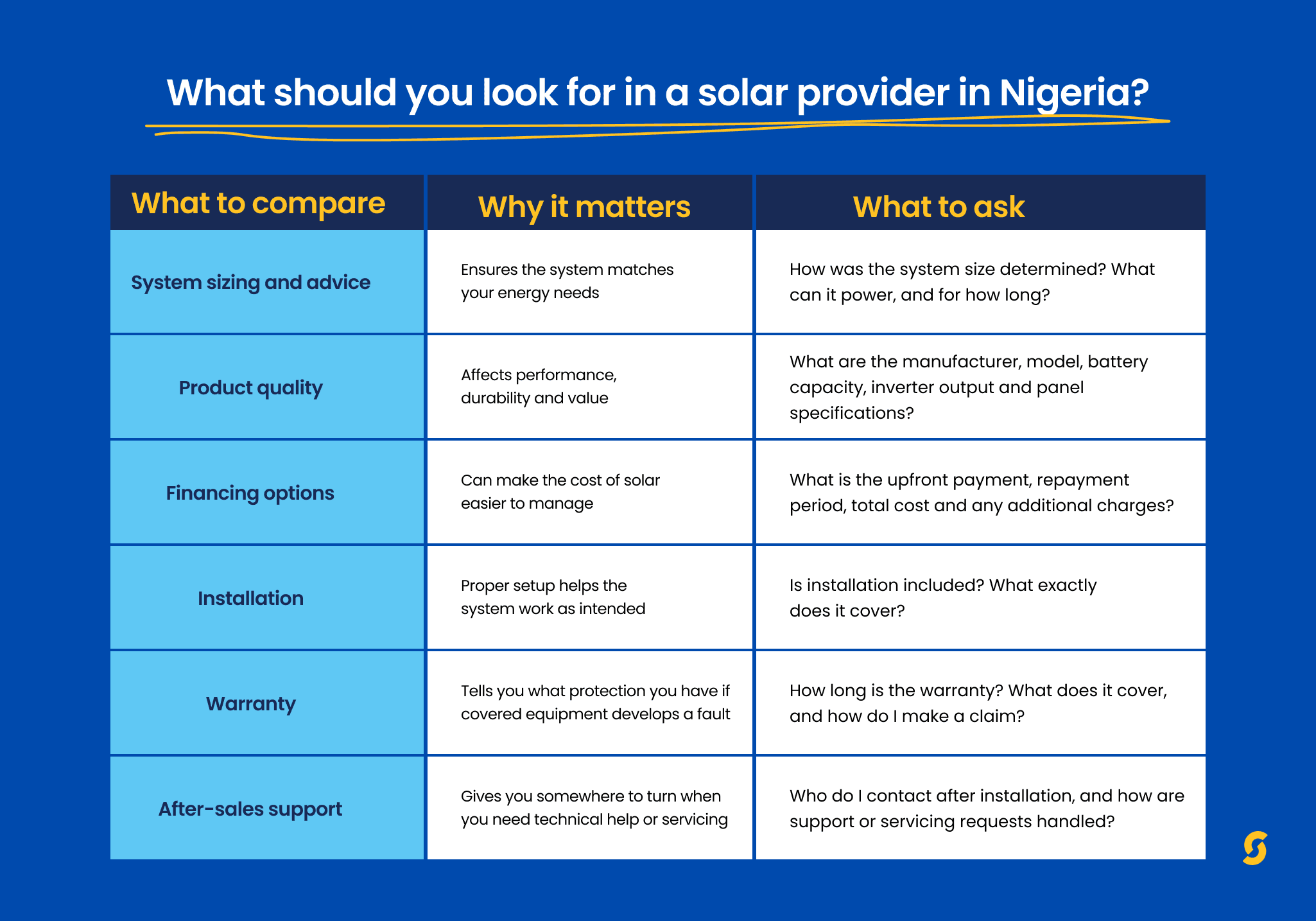
These factors give you a useful starting point for comparing solar companies in Nigeria. But before making a decision, it is worth looking at each one more closely.
Does the Provider Understand Your Power Needs?
The right solar system depends on what you want to power and how you use your appliances.
A provider should consider factors such as:
- The appliances and devices you want to run
- Their power requirements
- How frequently you use them
- How long you need backup power
- Your typical electricity usage
An inverter's capacity alone does not determine whether a system is suitable for your home or business.
A system that is too small may not meet your needs, while a system that is larger than necessary could increase your cost without providing a meaningful benefit.
Before accepting a recommendation, ask:
“How was this system size determined, and what exactly can it power?”
For more on system capacity, see What Can a 1kVA Inverter Power in a Nigerian Home?.
What Products and Specifications Are You Getting?
A solar system typically includes key components such as an inverter, battery and solar panels. You should know exactly what you are paying for.
Check whether the provider clearly states:
- Manufacturer and model
- Battery capacity
- Battery technology
- Inverter continuous output
- Inverter surge output
- Solar panel wattage
- Other components included in the system
Two systems with similar capacity ratings can have different specifications, battery technologies, warranties and included components.
That is why price alone is not enough to determine which system offers better value.
You should be able to identify the equipment you are buying and understand its specifications before you pay.
For more guidance, read 5 Solar Mistakes Nigerians Make and How to Avoid Them.
What Are Your Payment Options?
Solar can require a significant upfront payment, so financing can be an important part of the decision.
If a provider offers a payment plan, look beyond the monthly repayment and understand the total cost.
Ask:
- How much is required upfront?
- How long is the repayment period?
- What is the total amount payable?
- Are there additional charges?
- Which products or purchase amounts qualify?
Understanding the full payment terms allows you to compare different options properly and avoid unexpected costs.
What Does Installation Include?
Buying the equipment is only part of getting a solar system up and running.
Depending on the solution, installation may involve connecting the inverter and battery, positioning solar panels, integrating the system with the property's electrical setup and determining suitable equipment locations.
Before paying, ask:
“Is installation included, and exactly what does the installation cover?”
This helps you understand the full cost of your solar system and what you can expect once the equipment arrives.
What Does the Warranty Cover?
A warranty provides protection for covered equipment if it develops a qualifying fault within the specified warranty period.
However, warranty terms can vary between products.
Before buying, ask:
- How long is the warranty?
- Which components are covered?
- Which faults are covered?
- What conditions apply?
- Who handles warranty claims?
- How do you make a claim?
Do not assume that two products have the same warranty simply because they have similar specifications or prices.
It is also important to distinguish between warranty coverage and customer support. Support can help you troubleshoot a problem, while the warranty determines whether a particular fault qualifies for repair, replacement or another remedy.
Always review the warranty for the specific product or system you are purchasing.
What Happens After You Buy?
The relationship with your provider should not necessarily end after installation.
You may need technical assistance, servicing or help with a warranty issue later.
Before choosing a provider, find out:
- What customer-support channels are available?
- Is technical assistance available after installation?
- How are servicing requests handled?
- Who do you contact when there is a problem?
A provider's after-sales process is worth understanding before you make your purchase, rather than waiting until something goes wrong.
Should You Buy Solar Online or In Person?
Both options can work, depending on how you prefer to research and purchase.
Buying online allows you to browse products, compare specifications, review prices and order remotely.
Visiting a physical location gives you the opportunity to speak with a representative, discuss your energy requirements and explore available options in person.
Whichever route you choose, make sure you have enough information to understand what you are buying before making a payment.
Questions to Ask Before Buying Solar
Before paying for a solar system, make sure you can get clear answers to these questions:
- What can this system power?
- How long can it provide backup power?
- How was the system size determined?
- Which manufacturer and model are included?
- What are the battery capacity and inverter output?
- What battery technology is used?
- What is the inverter's surge output?
- What does the warranty cover and for how long?
- How do I make a warranty claim?
- Is installation included?
- What does installation cover?
- What support is available after installation?
- How are servicing requests handled?
- What payment options are available?
- What is the total amount I will pay?
- Are there any additional charges?
If a provider cannot clearly explain the system, costs, installation, warranty and support, take the time to get clarification before committing.
For a simple explanation of one of the most important components, see What Does a Solar Inverter Actually Do?.
So, How Do You Choose the Right Solar Provider?
There is no single factor that determines whether a solar provider is right for everyone.
Instead, look at the whole buying experience.
A provider should be able to understand your energy requirements, recommend an appropriate system, clearly explain the products and costs, provide transparent payment terms, handle installation and give you a clear path to support after your purchase.
Once you have compared these areas, you can make a more informed decision based on what matters most for your home or business.
How SunFi Approaches the Solar Buying Experience
This is where SunFi comes in.
SunFi brings several parts of the solar-buying journey together, from helping customers understand their energy needs to providing solar and backup-power products, financing, installation and customer support.
Needs-Based Recommendations
SunFi considers your appliances, their power requirements, how often you use them and how long you need backup power before recommending a solution.
Quality Products
SunFi offers products from established manufacturers, including OEM products, with published specifications for the inverter, battery and solar panels.
Financing Options
Eligible customers can access financing for larger systems from ₦1 million and above, allowing them to spread the cost instead of paying everything upfront.
Professional Installation
For applicable solar solutions, SunFi provides professional installation to help customers get their systems properly set up and ready to use.
Support After Purchase
Customers can reach SunFi for support by phone on 02018871099, via WhatsApp or in person at its physical locations.
Ready to Explore Your Solar Options?
Choosing solar is a significant decision. Take the time to understand your power needs, compare products and payment terms, check installation and warranty details, and find out what support is available after purchase.
If you are ready to explore your options, browse SunFi Sweet Deals or speak with a SunFi representative on WhatsApp for help finding a suitable solution.

Henry Adepegba
ABOUT AUTHOR
SEO Associate
Leave a Reply
Your email address will not be published.