Sometimes, As a Remote Worker, You're Only As Reliable As Your Power Supply
Learn how this remote worker stays in charge and up to date with all his deliverables with reliable power
August 19, 2026 3 minutes
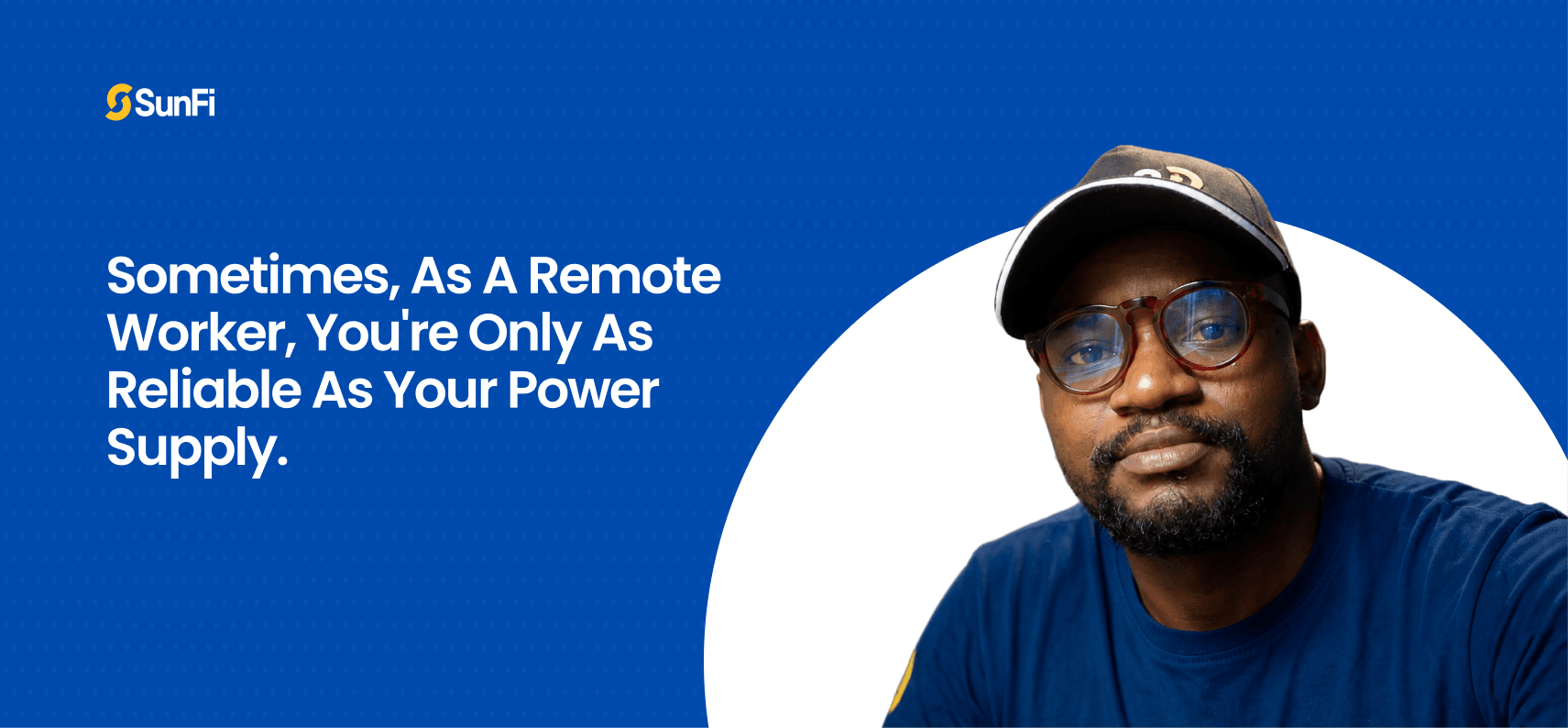
When Band A power was steady, Uchechukwu Emmanuel didn’t think he needed solar. Three months of unreliable supply later, he’d bought a generator, sold it within a week, and switched to a SunFi solar system. Here’s his story, and why he now tells friends solar is “absolutely worth it.”
Some people arrive at solar after years of frustration. For Uchechukwu Emmanuel, it took about three months.
A remote worker whose livelihood depends on staying online, Uchechukwu had electricity reliable enough that solar felt unnecessary. He was on Band A. Power mostly worked. Then, roughly three months ago, that changed, and it hit the one thing he couldn’t afford to lose: his ability to work.
Today he runs a 1.5kVA itel Power Tank system with two lithium-ion batteries, purchased from SunFi. It powers nearly everything in his home; TV, monitor, laptop, lights, a small fridge, sound system, and a piano keyboard, for his everyday essentials, he says, it’s been more than enough.
The generator that lasted a week
Before solar, Uchechukwu did what many Nigerians do when the grid gets unpredictable; he bought a generator, powerful enough to run his AC, figuring he could live with the trade-offs. He couldn’t.
Within a week, I realised I couldn’t stand the noise, and I was spending money on fuel almost every day.
At one point he was buying around 10 litres every couple of days. He sold the generator almost immediately and switched to solar. That experience shaped how he now thinks about the whole solar-versus-generator debate and it’s more nuanced than “one is cheaper.”
A better way to compare the cost
“People often compare only the purchase price and not the long-term cost of ownership,” he says. Generators, in his framing, are less capital intensive but far more operationally intensive: cheaper to buy, but then you’re constantly buying fuel, servicing the unit, and replacing parts. Solar is the mirror image - more capital intensive upfront, but far less operationally intensive afterwards, with running costs that drop sharply.
He acknowledges that both concerns are legitimate. Solar does cost more upfront, and over time it’s often the more economical option. That tension is exactly where financing matters. As Uchechukwu puts it, SunFi’s payment plan options “reduce the barrier of the initial cost and make that long-term value much more accessible.”
What reliable power actually changed
Work became predictable again. Before solar, he could promise a deliverable by 11 a.m., then lose power, and with it, his home router and any dependable connection. Deadlines slipped, and so did people’s confidence in his timelines. “Now, everything is much more predictable,” he says. “If I schedule a meeting, I know I’ll be there.” He can join video calls, camera on, without worrying about dropping offline halfway through.
Sleep and study time came back too. Reliable power means he can run his fan all night. “it blows really cold, almost like an AC, and once I turn it on, I fall asleep almost immediately.” And the study hours he used to lose to outages are now dependable: he once travelled all the way to Ikeja just to find somewhere with constant power to work overnight. “Now I can decide that from 10 p.m. until 1 a.m. I’m going to study, and it actually happens.”
“I don’t worry about charging my phone anymore. I could leave it at 1% and just plug it in, because I know there’s power,” he says. “Your quality of life improves by a significant order of magnitude the moment you have constant power.”
Would he tell a friend that solar is worth it?
“I would absolutely say it’s worth it.”
Although, he doesn’t dismiss the cost concern . But when he weighs the upfront price against everything that changed afterwards; the fuel he stopped buying, the workdays he no longer loses, the math lands firmly on solar’s side. It asked more of him at the start and gave back more over time. “It’s absolutely worth it because of how much it improves your quality of life, your productivity, and your peace of mind.”
Uchechukwu’s story started with an unreliable power situation and ended with control over his days, his work, his sleep, and his time. If you’re weighing the same switch, his advice is worth borrowing: don’t judge solar by the upfront price alone, but by everything it gives back once it’s running.
Ready to make the switch? Chat with a SunFi rep today

Henry Adepegba
ABOUT AUTHOR
SEO Associate
Leave a Reply
Your email address will not be published.